The Era of Personalized Software: Why Finance Teams Don't Always Need an ERP
For decades the answer to every business problem was a big system. With AI and low-code tools, a small personalized solution is often faster, cheaper and a better fit. Here is how I think about it.
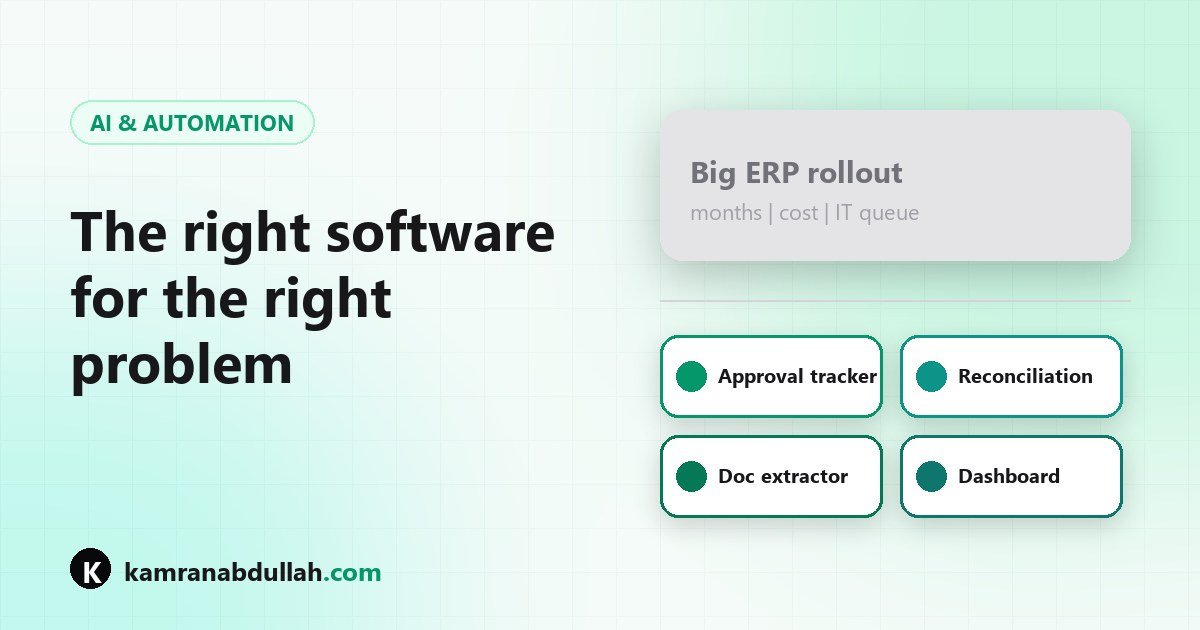
The old equation
For a long time the thinking went like this:
We have a problem, so we need software, so let's deploy a big system.
ERP. Complex applications. Long implementations, high costs, a queue at the IT department, and sometimes months before anyone sees a result.
I believe that equation is changing.
Small solutions for specific problems
Not every problem needs enterprise software. Often what a team needs is one small, personalized tool that solves one specific problem really well.
- A finance team may only need a simple approval tracker.
- Another department may need an automated reconciliation tool.
- Someone else needs a document extractor, a dashboard or a simple portal.
With AI, no-code and low-code platforms, cloud tools and scripting, many of these can now be built in days instead of quarters.
The person closest to the problem
The most interesting part is who can build them. The person closest to the problem can also become part of the solution.
Instead of "let's wait for IT to develop this", the better question is sometimes: can we build a simple solution ourselves?
That is exactly how my own path went, from finance ledgers and Excel to Power BI dashboards, SQL models and Python automation.
This does not replace enterprise systems
Large systems have a place, and they always will: shared master data, security, audit trails, scale. But for specific, repetitive, department-level problems, a personalized solution is often faster, cheaper and more practical.
A few honest guardrails if you go this way:
- Keep a clear owner for every small tool.
- Document what it does, even in half a page.
- Protect the data: access, backups, no sharing of sensitive files.
- Know when to graduate to a proper system.
Where AI fits
AI is not only about generating content, and not only about writing code. The real shift is that it helps ordinary business professionals turn their own problems into working solutions. That is the direction I'm most excited about.
The future may not be about having more software. It may be about having the right software for the right problem.
I first wrote about this on LinkedIn. Curious how you handle it in your team? Let's talk.
Enjoyed this post?
Follow my journey from finance ledgers to one-click automation.